Tomorrow Makers is Godrej Foundation's national platform for finding India's highest-potential students in its most underserved communities. Not a scholarship portal. Not a brochure. A working system that assesses aptitude across four disciplines, matches students to partner organisations, and connects them to mentors, coaching and peer communities that can change the trajectory of their lives.
The premise is simple and urgent: talent is everywhere, opportunity is not. Across India — from dense urban neighbourhoods to remote villages, from coastal towns to tribal hamlets — there are students with extraordinary potential who will never encounter the right programme, the right mentor, the right competition. Tomorrow Makers exists to find them.
This is the second project I've built for the Godrej ecosystem. The Godrej Foundation website was the first — and that relationship is what led here. When you build something well for a client, they come back with something harder. Tomorrow Makers was harder.
The design
3 Sided Coin designed the platform — the same studio that designed the Godrej Foundation site. But where the Foundation site is corporate and restrained, Tomorrow Makers is loud, bold, and unapologetically youthful.
The visual language is built around saturated colour — cyan, magenta, yellow, black — with oversized typography that fills the viewport. The hero doesn't whisper. "EVERYONE CAN BE GREAT AT SOMETHING" takes up the entire screen, layered over video of real students. The tone is editorial, direct, built to reach a 14-year-old on a phone, not a corporate board in a conference room.
Each of the four pathways gets its own colour identity: Science in teal, Arts in magenta, Invention in yellow, Service in dark. That gives each pathway a distinct visual personality while keeping everything under one design system.
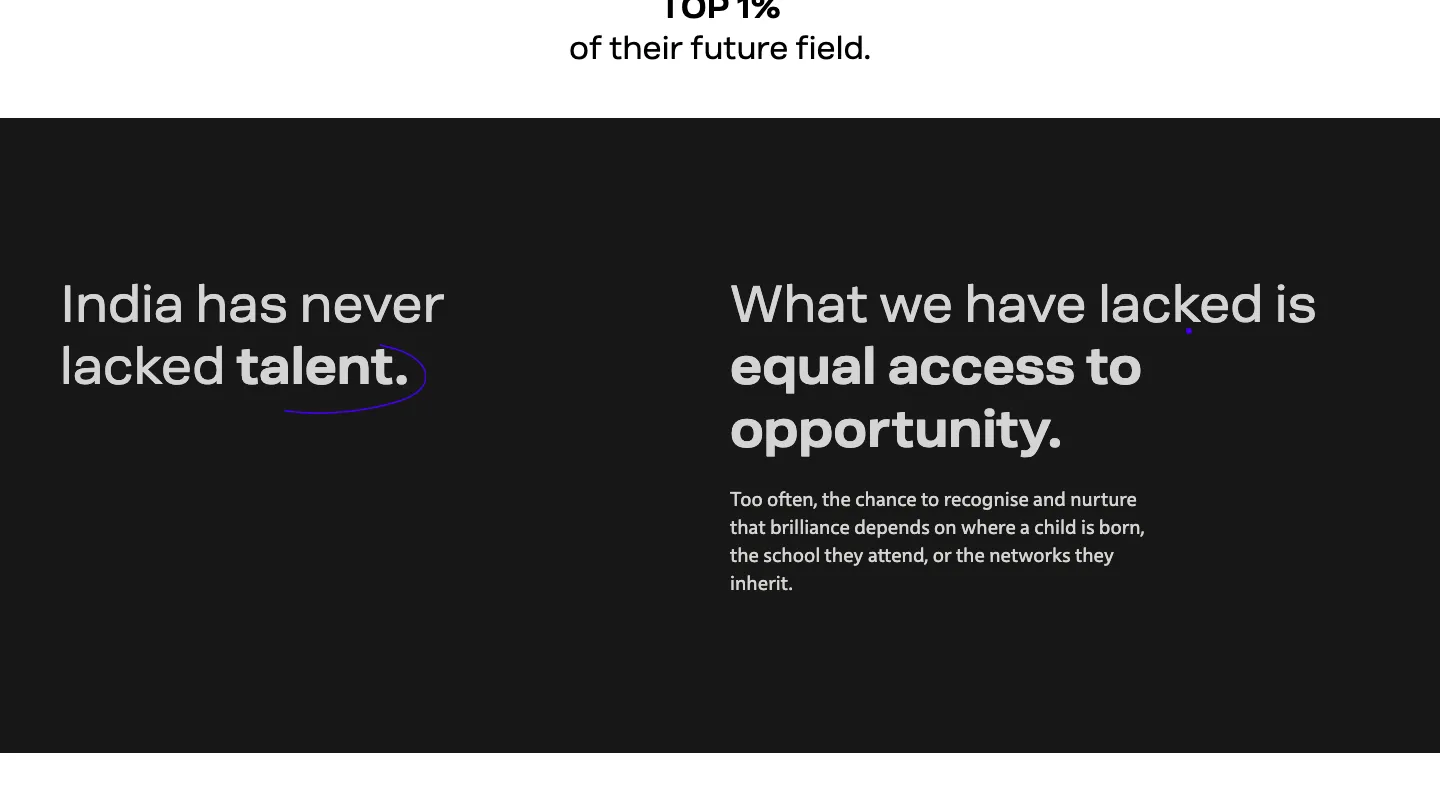
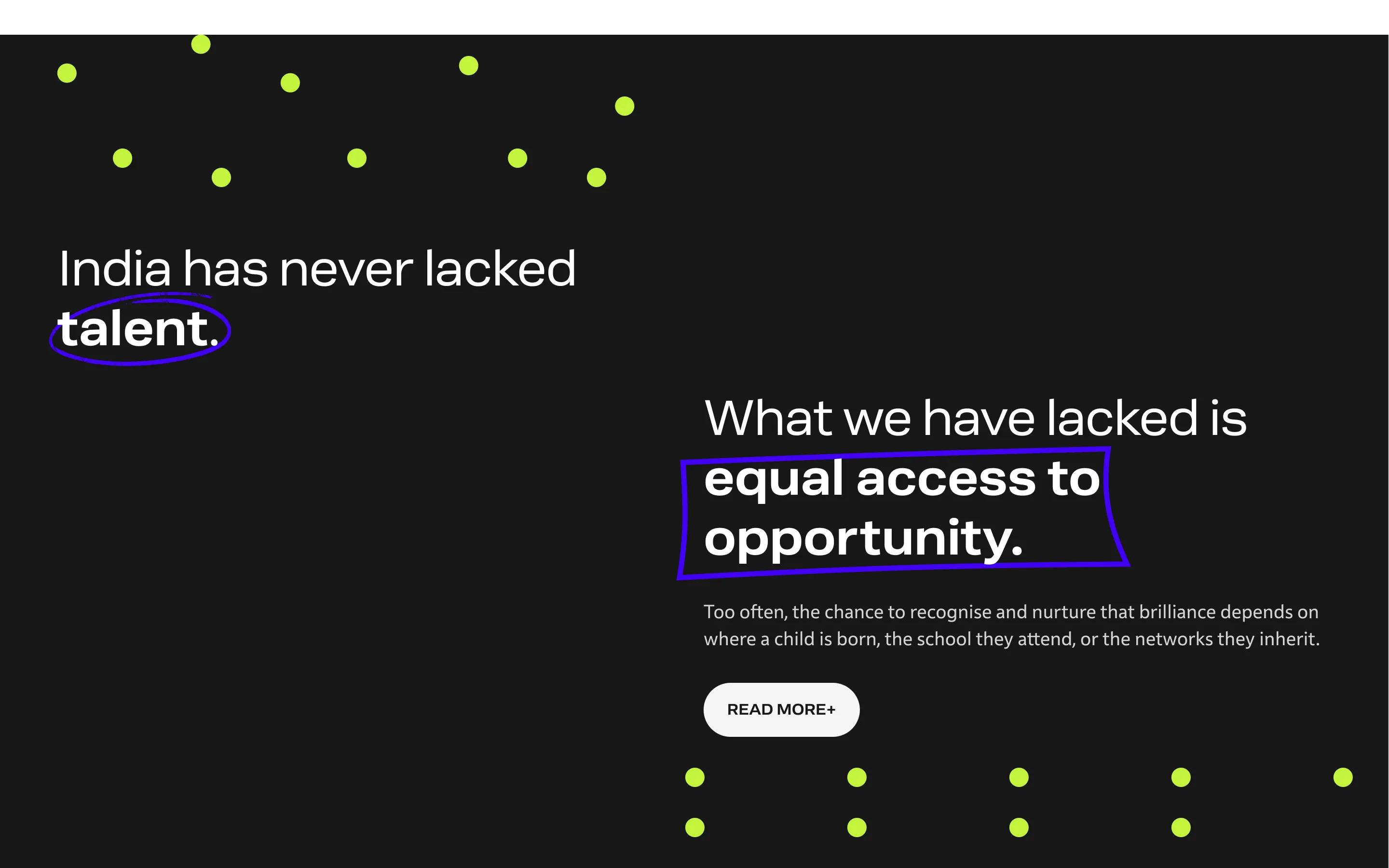
The core message — bold type, green dot-grid, designed to stop you scrolling.
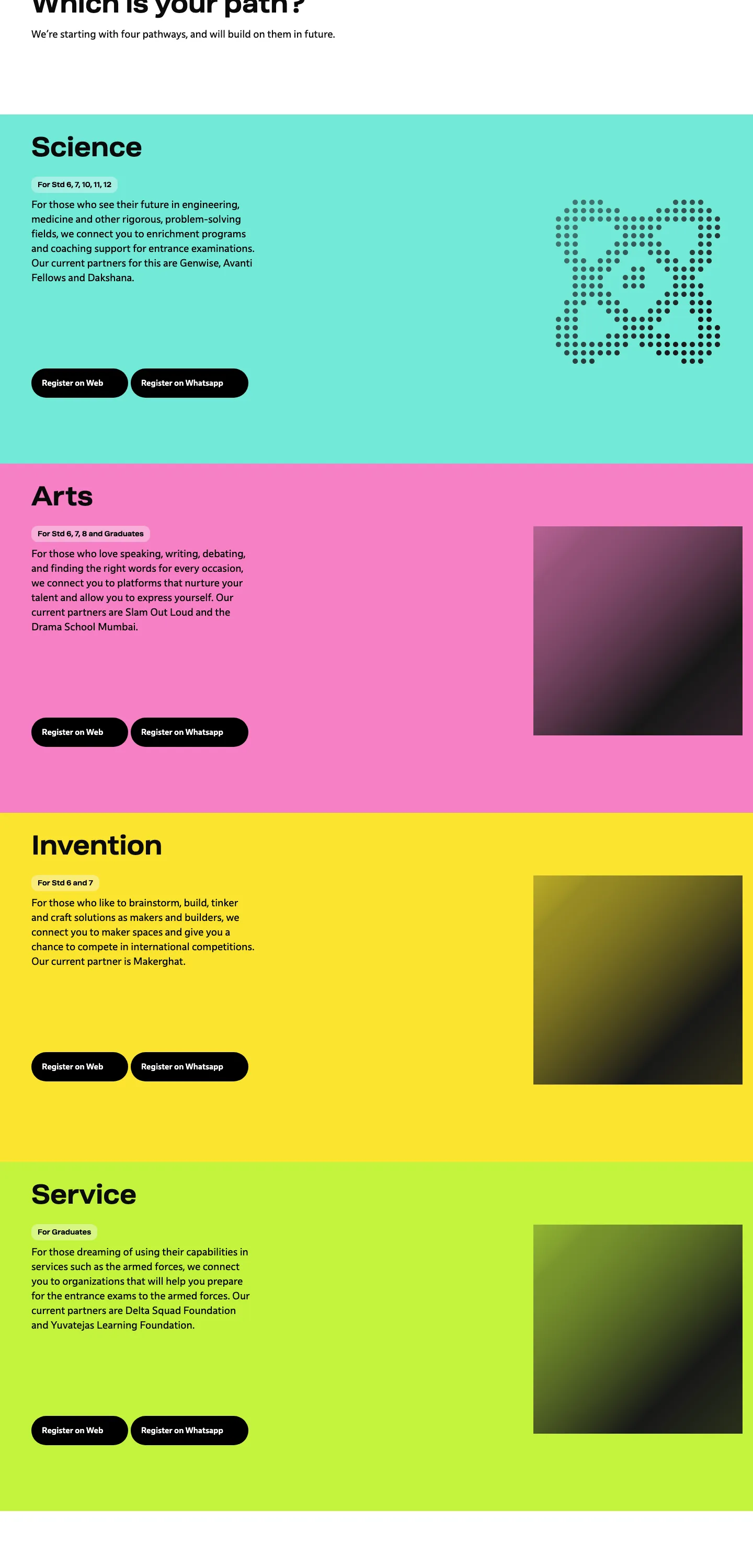
Each pathway — its own colour, its own audience, its own partner organisations.
Four pathways, one platform
The core of Tomorrow Makers is its four-pathway model. Each pathway targets a different aptitude, a different age group, and connects to different partner organisations — but they all flow through the same assessment and onboarding system.
The Pathways
Four routes, eight partner organisations.
Classes 10–12 → JEE/NEET coaching via Dakshana, Avanti Fellows, Genwise
Classes 6–8 + Graduates → Performing arts mentorship via Slam Out Loud, Drama School Mumbai
Classes 6–7 → Robotics, computing and maker spaces via MakerGhat
Graduates → Armed forces preparation via Delta Squad Foundation, Yuvatejas
The challenge was building a single platform that serves all four audiences without collapsing into a generic portal. A 12-year-old exploring robotics and a graduate preparing for the Indian Armed Forces have fundamentally different needs, different reading levels, different motivations for being on the site. The information architecture had to be simple enough for the youngest users while substantive enough for the oldest.
The assessment flow
Students can register through the website or via WhatsApp — text "Hi" to a number and the bot walks them through onboarding. This isn't a nice-to-have. In the communities Tomorrow Makers targets, a WhatsApp number is often more accessible than a web browser. Meeting students where they already are was a core design decision.
The assessment itself is available in 11 languages — for the arts in Classes 6–10 and the sciences in Classes 6–7 — because aptitude shouldn't be gated by English fluency. The process is three steps: assess aptitude in science, arts, invention or service; select high-potential candidates through a structured scoring process; and connect them to the right partner organisation for their pathway.
Need-based scholarships cover the cost for students who qualify — the platform isn't just identifying talent, it's removing every barrier between a student and the programme that can develop that talent.
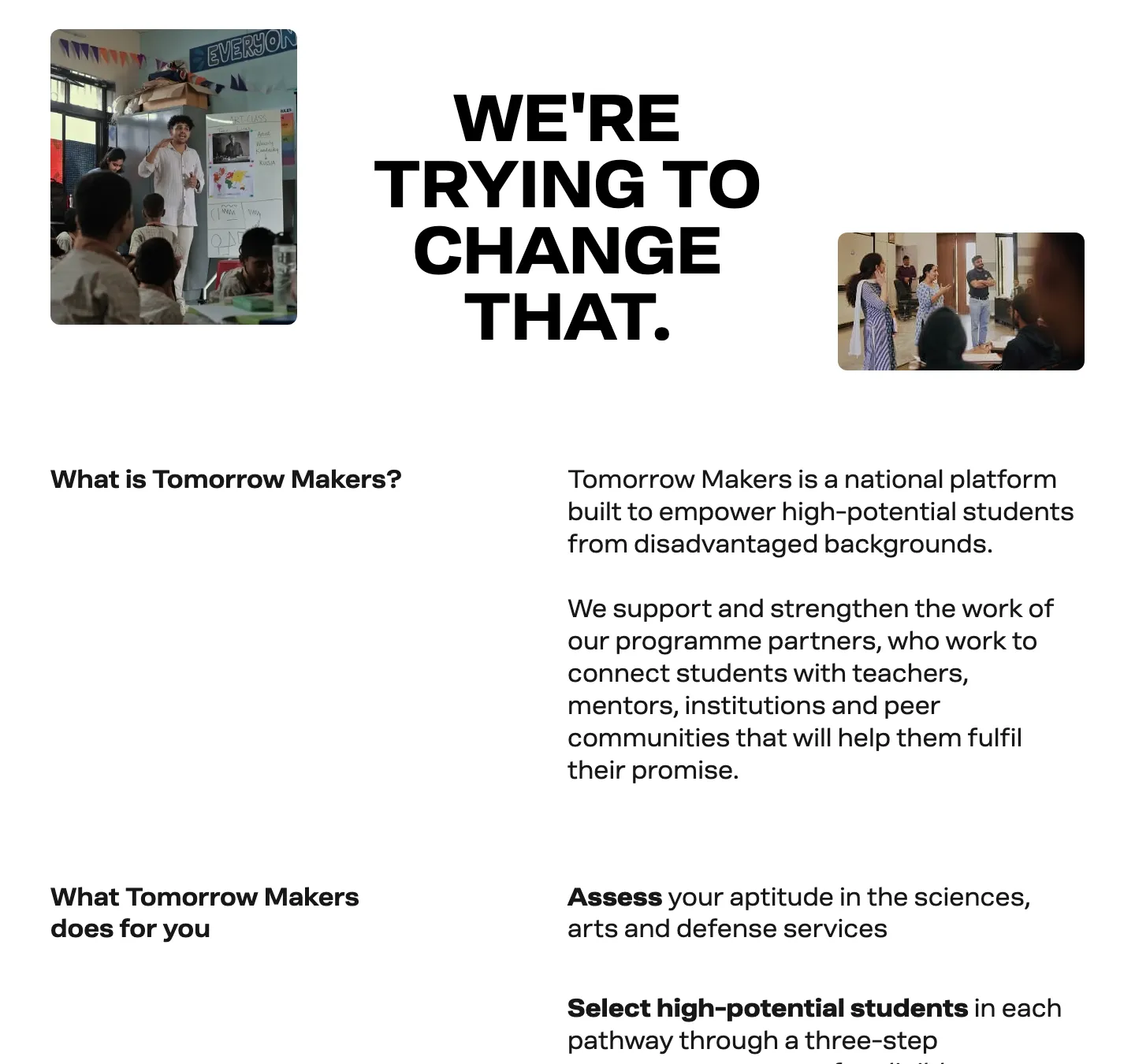
"We're trying to change that." — the platform's mission, told through bold type and editorial photography.
The stack
SvelteKit on Cloudflare Pages — the same foundation I built the Godrej Foundation site on. Tailwind for styling. The architectural DNA is shared: component-driven, statically rendered where possible, deployed on Cloudflare's edge so it loads fast on a mid-range phone.
The site is the front door, not the assessment engine. Registration and the assessment run on a separate platform at register.tomorrow-makers.in, and every "Register" button hands off to it; WhatsApp onboarding is a WhatsApp Business link into the programme's chatbot. What the site owns is everything a student and a parent read before they commit: the four pathway pages, eligibility by class, the partner organisations, the FAQs, and an Invention-pathway enquiry form that posts to a SvelteKit endpoint and on to the Apex mailer, behind reCAPTCHA.
The pathway colours are Tailwind theme tokens, so each pathway carries its own colour through every section it appears in without a single one-off style.
Platform at a Glance
What the build required.

The full homepage in one pass — hover (or scroll) to walk it top to bottom.
The Godrej thread
Tomorrow Makers launched as a Godrej Foundation initiative — the same trust whose website and CMS I built the year before. That earlier project went through two complete iterations (pre-rebrand and post-rebrand), and the relationship it built is what led to this one.
The two sites share architectural foundations — SvelteKit, Tailwind, Cloudflare — but they speak to completely different audiences. The Foundation site addresses donors, partners and corporate stakeholders. Tomorrow Makers talks to students. The tone, the typography, the colour palette, the interaction patterns — all different. Same engineering principles, entirely different product.
What I learned
- Building for impact is different from building for conversion. There's no add-to-cart here — the goal is getting a 14-year-old from a village in Maharashtra to take an aptitude test that could change their life. Every design decision filters through that lens.
- WhatsApp-first onboarding isn't optional when your users are in underserved communities. A website is one channel; the channel your audience already lives on is the one that matters.
- Design systems that serve multiple audiences within one product need colour as architecture, not just decoration. The pathway colours aren't aesthetic — they're wayfinding.
- The best briefs come from clients you've already proven yourself to. The Godrej Foundation site led directly to Tomorrow Makers — repeat work, not a pitch.
Next up
8 min · 2026
Building Without a Brief
Case Study · Nova Rock Tools